Simple Ways to Teach Children About Hajj at Home
There is something quietly miraculous about the month of Dhul Hijjah.
While millions of pilgrims make their way toward Makkah — some saving for decades, some answering a call they've felt since childhood — the rest of the Muslim world watches and prays, hearts tilted toward the same sacred geography. The Kaaba stands at the center, as it always has. The talbiyah rises from millions of throats across a thousand languages. And in homes around the world, Muslim families gather around tables, prayer rugs, and dinner conversations, trying to pass something essential to the next generation.
That something is Hajj. Not merely as a ritual obligation, one of the five pillars of Islam — though it is that. But as a living, breathing story of faith, sacrifice, endurance, and divine love. A story that began with a man willing to give up everything, a woman running desperately between two hills, a child lying still in trust, and a God who responded to every act of sincerity with mercy.
This is what our children deserve to inherit. Not a checklist of rituals, but a relationship with this story. A love for the journey before they are ever old enough to take it.
And the beautiful truth is: you can begin that teaching right now. At home. This week. Without special materials, without a madrassa, without anything other than intentionality and love.
Why Hajj Matters — Even for Children Who Can't Go Yet
Hajj Is a Story Before It Is an Obligation
Many parents instinctively wait until children are older to introduce Hajj. We assume the topic is too complex, too physical, too adult. But the story at the heart of Hajj — the story of Prophet Ibrahim (AS), Hajar (AS), and Ismail (AS) — is one of the most emotionally accessible, humanly relatable narratives in all of Islamic tradition.
A father's love. A mother's courage. A child's trust. A test that no one could face alone. And a mercy that arrived exactly when it was needed.
Children understand these things intuitively. They understand love and fear and trust long before they understand theology. And those emotional entry points are precisely where the teaching of Hajj should begin.
Allah says in the Quran:
"And proclaim to the people the Hajj [pilgrimage]; they will come to you on foot and on every lean camel; they will come from every distant pass." — Surah Al-Hajj (22:27)
This ayah describes a call that has been answered continuously for thousands of years. When we teach our children about Hajj, we are connecting them to that call — not just as a future obligation, but as a living inheritance.
The Prophet's Words on Teaching Young Minds
The Prophet Muhammad (PBUH) understood that children who are raised with love for Islamic practices carry that love for life. He was known to be tender with children, to answer their questions seriously, to include them in moments of worship and reflection.
It is narrated in Sahih Muslim that the Prophet (PBUH) said: "Every one of you is a shepherd and is responsible for his flock." Parents are the first shepherds of their children's spiritual lives. And Hajj season is one of the most powerful annual opportunities to do that shepherding intentionally.
Start With the Story — It's Where Everything Begins
The Three People at the Heart of Hajj
Before any craft, activity, or lesson — tell the story.
Every ritual of Hajj traces back to three human beings who lived thousands of years ago and whose acts of faith were so sincere, so complete, that Allah preserved them in the rites of an entire pilgrimage. Understanding who they were and what they did transforms Hajj from an abstract obligation into something deeply personal.
Prophet Ibrahim (AS):
Ibrahim (AS) is called Khalilullah — the intimate friend of Allah. He was a man who was tested repeatedly and passed each test not through ease, but through a faith so steady it had no trembling. He left his homeland. He was thrown into fire. He was asked to sacrifice his son. And in every instance, he surrendered — not out of blind obedience, but out of the most conscious, deliberate love for Allah.
Allah says:
"And who is better in religion than one who submits himself to Allah while being a doer of good and follows the religion of Ibrahim, inclining toward truth? And Allah took Ibrahim as an intimate friend." — Surah An-Nisa (4:125)
Hajar (AS):
She is perhaps the most quietly extraordinary figure in Islamic history. Left alone in a barren valley with no water and an infant son, she did not despair — she moved. She ran between Safa and Marwa, searching, refusing to surrender to hopelessness. When water finally burst from the earth at her son's feet, she contained it with her hands and said: zamzam — gather, gather. Her running became a rite. Her courage became a symbol. Every pilgrim who walks between Safa and Marwa is walking in her footsteps.
Ismail (AS):
A child. Young, obedient, trusting. When Ibrahim (AS) told his son about the divine command — that he had been shown in a dream that he must sacrifice him — Ismail's response was breathtaking in its simplicity:
"He said: O my father, do as you are commanded. You will find me, if Allah wills, of the steadfast." — Surah As-Saffat (37:102)
No drama. No bargaining. Just: do what you must do, and I will be okay.
These three figures and their stories are the living soul of Hajj. Teach them to your children like you would tell your favorite family story — with detail, with feeling, with love for the people in it.
Practical Ways to Teach Hajj at Home
1. Make Storytelling a Dhul Hijjah Tradition
The most powerful teaching tool you have is your voice.
Set aside time during the first ten days of Dhul Hijjah — or in the days leading up to Eid al-Adha — to sit with your children and tell the story of Ibrahim (AS), Hajar (AS), and Ismail (AS) in stages. Don't rush through it. Let the children ask questions. Let them feel the weight of it.
Some questions to explore together:
How do you think Hajar felt when Ibrahim left her in the desert?
What do you think Ismail was thinking when his father told him?
Why do you think Allah tested Ibrahim so many times?
What would you have done if you were Hajar, with no water and a crying baby?
These conversations do something that memorized facts cannot. They build empathy. They make the people of Hajj feel real. And when children feel that reality, the rituals stop being abstract symbols and start being acts of love.
2. Create a Simple "Hajj Journey" at Home
Children learn through the body as much as the mind. One of the most memorable and beloved home Hajj activities — reported by Muslim families around the world — involves creating a simple physical experience of Hajj's rites.
Here's how to do it:
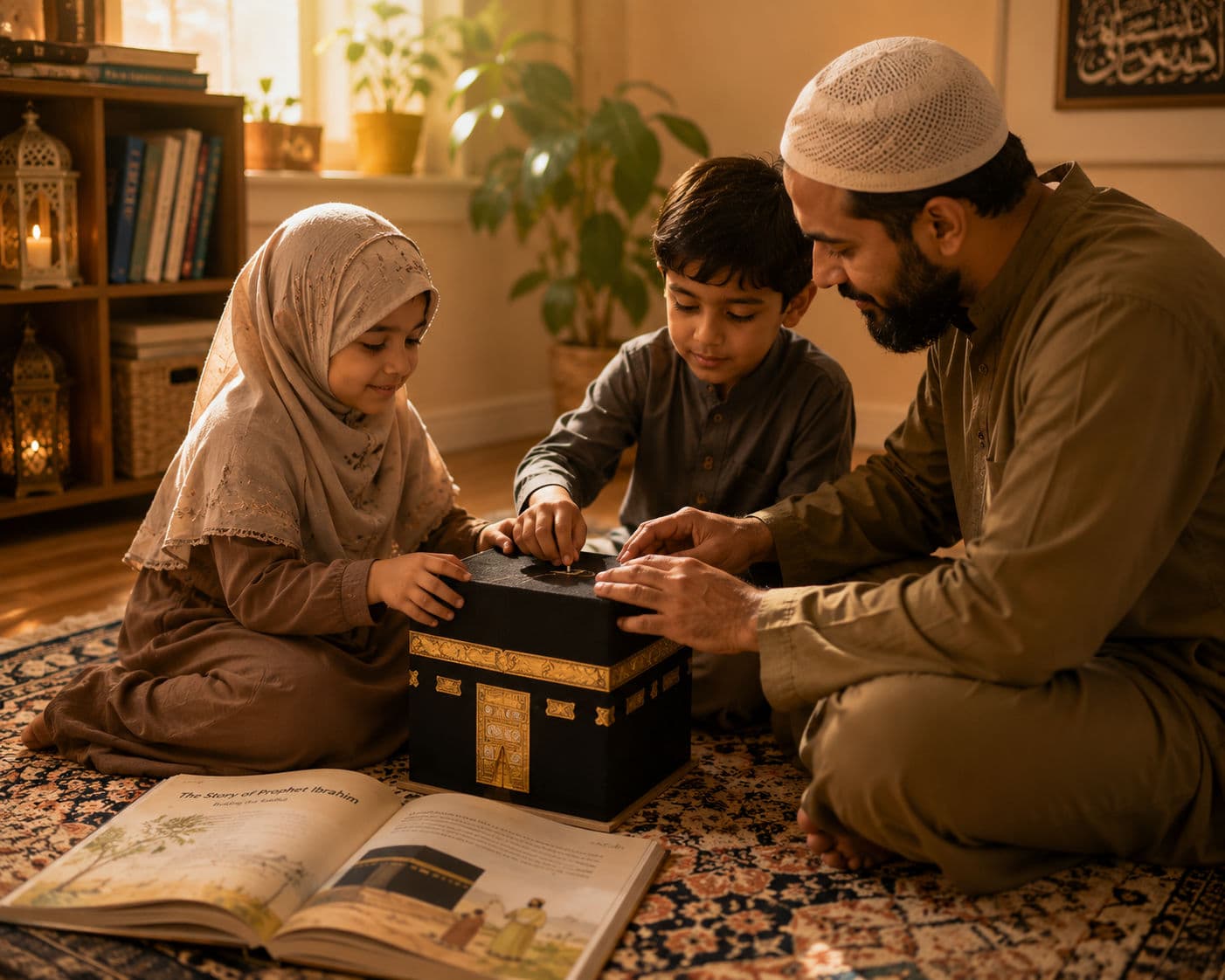
Make a simple Kaaba: Use a cardboard box, cover it in black paper or fabric, and place gold-colored paper or ribbon around it. It doesn't need to be elaborate. The point is to give children something to orient toward.
Practice Tawaf: Walk around the Kaaba representation seven times, together, as a family. Explain that Tawaf means we circle the house of Allah, the way our hearts always circle around Him.
Walk between "Safa and Marwa": Designate two points in a hallway or room. Walk between them seven times, telling the story of Hajar as you go. Ask the children: What was she feeling on the first walk? On the fifth? On the seventh?
Practice the talbiyah together: Labbayk Allahumma labbayk. Labbayk la sharika laka labbayk. Innal hamda wan ni'mata laka wal mulk. La sharika lak.
Translate it for your children: "Here I am, O Allah, here I am. Here I am, You have no partner, here I am. Indeed, all praise, grace, and sovereignty belong to You. You have no partner."
This is what millions of pilgrims say. Say it together. Say it in Arabic, then in English. Let it land.
Talk about standing at Arafah: Explain that on the 9th of Dhul Hijjah, pilgrims stand on the plain of Arafah and make dua — just making dua, for hours, asking Allah for everything. Ask your children: If you could stand at Arafah right now and ask Allah for anything, what would you ask for?
Let them answer. Write their duas down together.
3. Watch Hajj Coverage Together
During the days of Hajj, live coverage is broadcast globally. Sit with your children and watch. Let them see the sea of white. Let them see people weeping. Let them hear the talbiyah.
Point things out as you watch:
See how everyone is wearing the same white cloth? That's called Ihram. It means no one is richer or poorer here — everyone is equal before Allah.
See those people running? They're doing Sa'i, like Hajar did.
That's the Kaaba. That's what we face when we pray.
The visual experience of Hajj — even through a screen — can be deeply moving for children who know the story behind what they're seeing.
4. Make Dua as a Family on the Day of Arafah
The 9th of Dhul Hijjah — the Day of Arafah — is one of the most sacred days in the Islamic year. The Prophet (PBUH) said:
"There is no day on which Allah frees more people from the Fire than the Day of Arafah." — Sahih Muslim
Even for those who are not performing Hajj, this day carries immense spiritual weight. Fast together if your children are old enough, or simply mark the day intentionally.
In the afternoon — when the pilgrims at Arafah are standing and making dua — gather as a family. Turn off the screens. Sit together. Each person, including every child, makes their own dua out loud or in their heart.
This creates something remarkable: a family tradition of sacred time. Children who grow up making dua on Arafah as part of their family rhythm develop an intuitive understanding of the day's weight — one that no textbook can replicate.
5. Teach the Meaning of Qurbani
Eid al-Adha and its sacrifice are often the part of Hajj season that children experience most directly. Use it as a teaching moment.
Explain the three portions of Qurbani:
One portion for the family
One portion for friends and neighbors
One portion for those who are in need
Then make it tangible. Let children help prepare food to give away. Let them, if possible, personally deliver something to a neighbor or to someone who could use it.
The Prophet (PBUH) said: "The one who looks after a widow or a poor person is like a mujahid (warrior) who fights for Allah's cause, or like the one who performs prayers all the night and fasts all the day." (Sahih Bukhari)
When children give with their own hands, the lesson of Eid al-Adha stops being theoretical.
6. Learn the Arabic of Hajj
One of the most beautiful gifts you can give a child during Hajj season is familiarity with the Arabic words and phrases that define it.
Start simply:
Arabic | Meaning |
|---|---|
Labbayk Allahumma labbayk | Here I am, O Allah |
Tawaf | Circling the Kaaba |
Sa'i | Walking between Safa and Marwa |
Arafah | The plain where pilgrims stand |
Zamzam | The sacred water |
Ihram | The state of consecration |
Qurbani / Udhiyah | The ritual sacrifice |
Eid al-Adha | The Festival of Sacrifice |
When children learn these words, Hajj becomes less foreign and more familiar. And familiarity breeds love.
This is where structured Arabic learning — like the one-on-one lessons at Araby Academy — makes a meaningful difference. Children who are actively learning Arabic find that the Hajj vocabulary feels like part of a living language they are growing into, not isolated terms to memorize and forget.
7. Create a "Hajj Memory Box"
This is a tradition several Muslim families have found deeply meaningful across generations.
Each year during Dhul Hijjah, the family adds something to a special box or folder:
A piece of paper with that year's family duas
A drawing the children made of the Kaaba or the Hajj journey
A printout of an ayah related to Hajj
A note about something new they learned about Ibrahim (AS)
A photo from your family's Eid al-Adha gathering
Year after year, the box fills. And when a child grows older and holds in their hands the Eid cards they drew at age five, the duas they wrote at age nine, the reflections they scribbled at twelve — they hold their own spiritual history. They hold evidence that this has always mattered. That they have always been part of this story.
Building Emotional Love for the Kaaba and Makkah
The Goal Is Not Knowledge — It's Longing
There is a difference between a child who knows what the Kaaba is and a child who longs to see it.
The second child has been given something far more valuable.
When we teach about Hajj, the deepest goal is not factual knowledge. It is shawq — that sacred Islamic concept of yearning, of a heart oriented toward something holy. Children who grow up with this longing tend to become adults who make Hajj not as a distant obligation finally checked off a list, but as a homecoming they've been moving toward their whole lives.
How do you build that longing?
Tell stories with love. When you speak about the Kaaba, let your voice carry your own feeling for it. Children absorb our emotional relationship with things more than our words about them.
Make dua for them to visit. Sincerely, in front of them: "O Allah, grant my children the chance to stand before Your house." Hearing their parents make dua for their Hajj plants a seed.
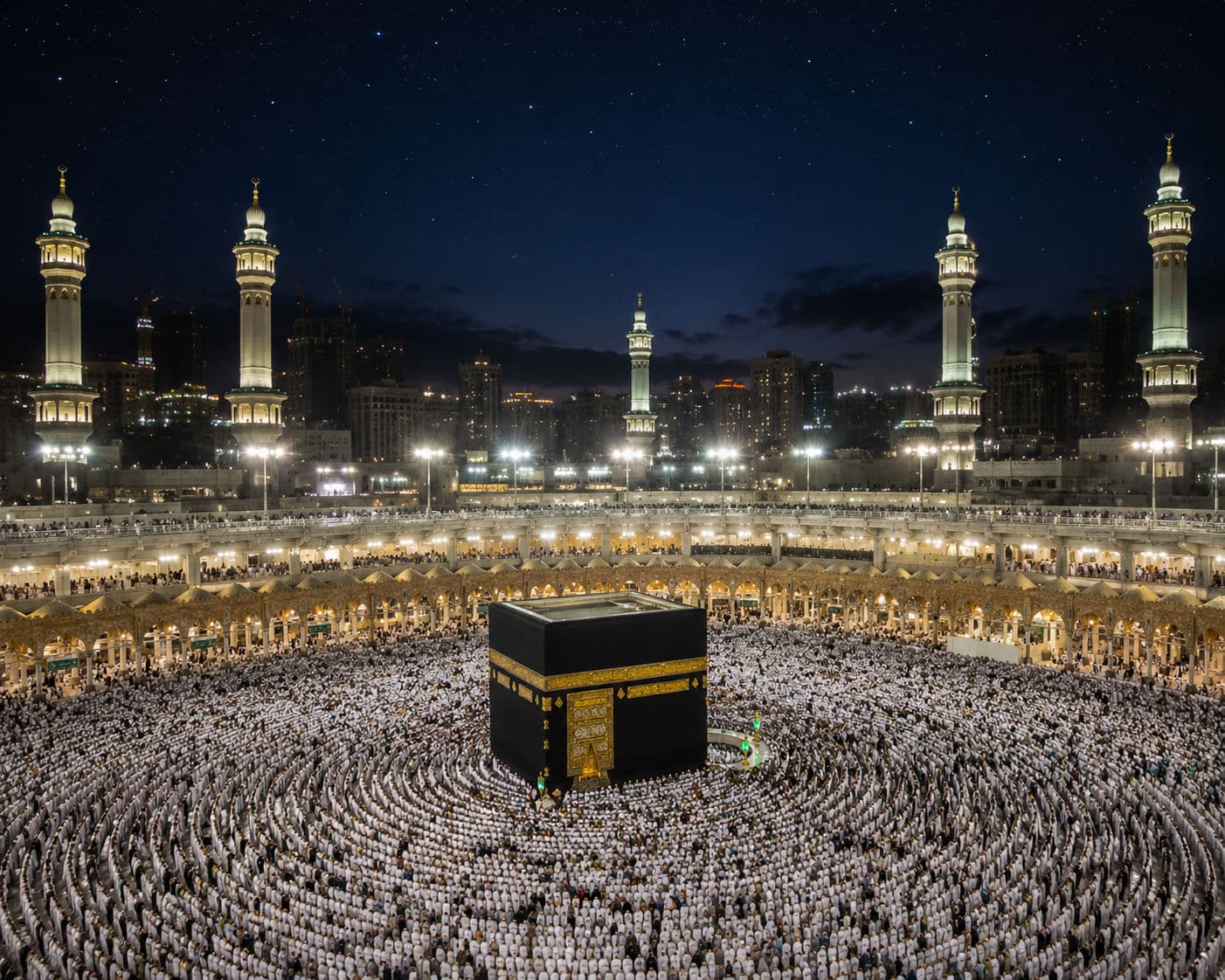
Show them images thoughtfully. A photograph of the Masjid al-Haram at night, illuminated and vast, surrounded by thousands of worshippers — that image carries meaning. Look at it together. Talk about what it would feel like to be there.
Connect Hajj to your daily prayers. When children stand for salah, remind them occasionally: "Do you know what direction we're facing? We're facing the Kaaba, right now, from here."
That single sentence — said once in a while, not too often — builds a continuous, living thread between a child's daily prayer and the most sacred place on earth.
What to Avoid When Teaching Children About Hajj
Common Mistakes That Reduce Rather Than Build Connection
Even the most well-intentioned parents can unintentionally undermine the spiritual richness of Hajj when teaching it. Here are the most common pitfalls — and what to do instead:
Turning Hajj into a memorization exercise
If the primary experience of Hajj for a child is being quizzed — What are the five pillars? What day is Arafah? How many times do you circle the Kaaba? — then Hajj becomes a school subject rather than a living faith.
Knowledge is important. But lead with love and story, and let the knowledge follow naturally from the relationship.
Making Hajj feel impossibly distant
Phrases like "when you're grown up" and "only for adults" unintentionally frame Hajj as something that has nothing to do with a child's present life. Instead, help them feel connected to Hajj right now — through dua, through storytelling, through home activities.
Focusing on rules without the reasons
Children can handle why. When you explain that pilgrims enter Ihram to become equal before Allah, that lands differently than simply stating that pilgrims wear white. Always reach for the meaning underneath the action.
Using fear as a motivator
Describing Hajj primarily through the lens of obligation, fear of missing out on its reward, or anxiety about not performing it correctly — creates anxiety rather than love. The Prophet (PBUH) said: "Make things easy and do not make them difficult." (Sahih Bukhari) That principle applies beautifully to how we introduce Hajj to children.
Waiting too long to begin
Some parents wait until children are ten or twelve to begin teaching about Hajj, assuming younger children can't understand it. But children as young as three or four can understand love, courage, and trust. Begin there. Build complexity gradually, year by year. By the time they're teenagers, the foundation will be solid.
Making Dhul Hijjah a Family Season of Spiritual Renewal
Beyond Teaching: Living the Season Together
Hajj season is not only about teaching children what happens in Makkah. It's also an invitation for the entire family to deepen its own spiritual life.
The first ten days of Dhul Hijjah are among the most virtuous days of the Islamic year. Ibn Abbas (RA) narrated that the Prophet (PBUH) said:
"There are no days in which righteous deeds are more beloved to Allah than these ten days." — Sahih Bukhari
Consider establishing family practices during these days:
Extra prayers together — even just two rakaat as a family, consciously offered for these blessed days
Dhikr after meals — Subhanallah, Alhamdulillah, Allahu Akbar — said together, casually, at the table
Daily Quran reading — even a short passage, read aloud and briefly reflected on
Fasting on Arafah — for children old enough to try a partial fast, this is a meaningful first experience
Giving sadaqah — regularly, visibly, so children see generosity as a family value during this season
When children experience Dhul Hijjah as a season of warmth, togetherness, and extra spiritual attention — not merely as the time before Eid — they carry that feeling forward. Decades later, the memory of the family gathering for dhikr after iftar, or the story their parent told on the ninth night, will still be with them.
That is legacy. That is Islamic parenting at its most powerful.
FAQ: Teaching Children About Hajj at Home
At what age should I start teaching my child about Hajj?
There is no minimum age for age-appropriate Islamic storytelling. Children as young as three or four can understand simple versions of Ibrahim's (AS) story: a father who loved Allah, a mother who was brave, a boy who trusted. Each year, build on what they know. By the time they're ten or eleven, they can understand the full spiritual and historical weight of Hajj.
My child asks why we can't go to Hajj now. What should I say?
What a beautiful question to receive — it means the longing has already been planted. Be honest and warm: "Hajj is a journey we hope and pray to make together one day, insha'Allah. For now, we honor it from home by learning about it, making dua, and following the sunnah of the day." Then make dua with them, right then, to go together one day.
Is it appropriate for children to watch live Hajj coverage?
Absolutely — with guidance. Watching together is far more meaningful than watching alone. Narrate what you see. Answer questions. Let them witness the talbiyah, the Tawaf, the sea of white. For children who know the story behind what they're seeing, live Hajj coverage can be genuinely moving and spiritually formative.
How do I explain Qurbani (sacrifice) to a young child?
Start with the story of Ibrahim (AS) and the ram — a story of complete trust in Allah and His mercy. Then explain that we sacrifice an animal to remember Ibrahim's love for Allah, to express our own gratitude, and to share our blessing with those who have less. Emphasize the sharing. Let them help prepare food to give away. The lesson of generosity is the lesson a child can feel and practice.
What if I don't know much about Hajj myself? Can I still teach my child?
Yes — and your honesty about learning together is itself a powerful lesson. Children who see their parents saying "Let's find out together" learn that seeking knowledge is a lifelong, humble, beautiful practice. Use resources, children's Islamic books about Hajj, and educational platforms like Araby Academy to learn alongside your child. The journey of learning is part of the gift.
Are there books or resources you recommend for teaching Hajj to children?
Look for illustrated Islamic storybooks about Prophet Ibrahim (AS) and Hajj for younger children. For older children, explore accessible biographies of the prophets and Quranic tafsir written for families. Learning Arabic — even at a foundational level — gives children direct access to the Quranic account of Ibrahim's story in Allah's own words. Araby Academy's one-on-one Arabic and Quran lessons can be a meaningful starting point for that journey.
How do I keep Hajj meaningful year after year and not repetitive?
Deepen rather than repeat. Each year, add a new layer. If last year you told the story simply, this year explore the theology. If last year you walked around a cardboard Kaaba, this year have a family discussion about what submission (Islam) really means. If last year the children were passive, this year let them lead the storytelling. The story of Hajj is deep enough to be explored for a lifetime — and it should be.
Final Thoughts: The Greatest Gift You Can Give This Hajj Season
There is a dua that Ibrahim (AS) made, thousands of years ago, standing near the place where the Kaaba would be built:
"Our Lord, make us Muslims [in submission] to You and from our descendants a Muslim nation to You. And show us our rites and accept our repentance. Indeed, You are the Accepting of Repentance, the Merciful." — Surah Al-Baqarah (2:128)
He made dua for his children. And for their children. And for the generations stretching far beyond what he could see.
You are part of the answer to that dua.
Every parent who sits with their child this Dhul Hijjah and says, let me tell you about Ibrahim and Hajar and Ismail, is participating in something that goes back to the very beginning of this tradition. You are not just teaching a lesson. You are passing a torch.
The children who grow up loving Hajj before they ever go — who have wept at stories of Hajar's courage, who have felt the weight of Ibrahim's test, who have whispered the talbiyah in their own homes long before they stand in Makkah — those children become the adults who make Hajj with full hearts. They become the parents who teach their own children with the same love they were taught with.
That is the cycle. That is the inheritance.
This Hajj season, let your home be a place where that inheritance is carefully, lovingly, joyfully passed on.
And if you want to give your children the additional gift of Arabic — so that one day they can read the story of Ibrahim in the Quran, in Allah's own words, with understanding — that journey can begin today. At Araby Academy, our one-on-one Quran and Arabic lessons are built for real families, at real stages of life, with teachers who genuinely love what they teach.
Because the Quran that describes Ibrahim's sacrifice, Hajar's courage, and Allah's mercy — that Quran is waiting to be read by your child, in Arabic, with their own voice.
What a gift that would be.
Dhul Hijjah Mubarak. May Allah accept from all of us, and may He grant every Muslim family a Hajj that changes them forever.