How to Make Eid al-Adha Meaningful for Children Beyond New Clothes and Gifts
Every year, Eid al-Adha arrives with its familiar rituals — the smell of grilled meat in the neighborhood, children running around in crisp new outfits, and families gathering around tables heavy with food. It's beautiful. It really is.
But somewhere between the excitement of new clothes and the anticipation of gifts, the deeper heartbeat of this occasion can get lost — especially for children who don't yet understand what they're actually celebrating.
Eid al-Adha is one of the most spiritually rich occasions in the Islamic calendar. It commemorates a story of profound trust, sacrifice, and submission to Allah — the story of Prophet Ibrahim (peace be upon him) and his willingness to give up everything he loved. That's not a small story. That's the kind of story that can shape a child's entire worldview, if we take the time to tell it right.
The good news? You don't need to turn Eid into a lecture. With the right approach, you can make it deeply meaningful and genuinely joyful — and this guide will show you exactly how.
Why Eid al-Adha Is About More Than Celebration
Before we talk about what to do, it's worth understanding what we're working with.
The Story at the Heart of Eid al-Adha
Eid al-Adha — also known as the Festival of Sacrifice — marks the climax of the Hajj pilgrimage and commemorates Prophet Ibrahim's (AS) willingness to sacrifice his son Ismail (AS) in obedience to Allah's command. At the last moment, Allah replaced Ismail with a ram, accepting Ibrahim's devotion and sparing his son.
This story is not just historical. It's theological, emotional, and deeply human. It's about:
Trust — believing in Allah even when you don't understand why
Sacrifice — giving up something precious for a higher purpose
Gratitude — recognizing that everything we have is a gift from Allah
Submission — the literal meaning of Islam itself
When children understand this story at its core, Eid al-Adha stops being just "the holiday where we eat a lot of meat." It becomes something they carry inside them.
Why Children Often Miss the Point
Most children experience Eid al-Adha as a social event. And that's not entirely a bad thing — community, joy, and family togetherness are genuine Islamic values.
But without intentional teaching, children absorb the cultural surface of Eid without its spiritual depth. They grow up knowing that we sacrifice an animal, without really knowing why — and more importantly, without understanding what that sacrifice is asking of them personally.
The gap isn't their fault. It's ours, as parents and educators. And it's fixable.
Start With the Story — Told the Right Way
How Do You Explain Eid al-Adha to a Child?
The first and most important thing you can do is tell the story of Prophet Ibrahim (AS) in a way that resonates with your child's age and emotional world.
For young children (ages 4–7):
Keep it simple and emotionally relatable. Focus on love and trust.
"Ibrahim loved his son Ismail very, very much. But he loved Allah even more. And when Allah asked Ibrahim to show how much he trusted Him, Ibrahim said yes — even though it was the hardest thing he'd ever done. Allah saw how much Ibrahim loved Him, and He was so pleased that He sent a ram instead. That's why we sacrifice an animal — to remember Ibrahim's love for Allah, and to share with people who don't have enough."
For older children (ages 8–12):
You can go deeper. Talk about what it feels like to be asked to give up something you love. Ask them:
"Have you ever had to give up something you really wanted because it was the right thing to do?"
"What do you think Ibrahim was feeling when he received Allah's command?"
"What does it mean to really trust someone — even when you don't understand their reasons?"
These questions don't just teach Islamic history. They build tafakkur — the Islamic practice of deep reflection.
For teenagers:
Engage them with the theological weight of the story. Ibrahim's faith wasn't blind obedience — it was conscious, deliberate surrender after genuine struggle. That's an enormously sophisticated spiritual stance. Teenagers can handle that conversation, and many are hungry for it.
Make the Sacrifice Itself Educational
Should Children Watch the Qurbani?
This is a question many parents wrestle with, and the honest answer is: it depends on the child, and it depends on how it's framed.
The sacrifice — Qurbani — is not meant to be entertainment or spectacle. But it is meant to be witnessed and understood. Here's how to approach it thoughtfully:
For children who are ready:
Explain beforehand what is going to happen and why
Frame it as an act of worship, not violence
Emphasize the mercy in how it should be done (Islam requires minimizing the animal's distress)
Discuss what happens to the meat afterward — that it's shared with family, neighbors, and those in need
Questions to discuss with your child before the Qurbani:
Where does our food come from, and why is it important to remember that?
What does it mean to be grateful for having more than others?
How does sharing the meat connect to Ibrahim's story?
The goal is not to desensitize children to sacrifice, but to help them understand that there is meaning and mercy in the act — that it is done with intention, gratitude, and love for Allah.
Turn Eid al-Adha Into a Learning Experience at Home
Practical Activities That Teach Deeper Meaning
You don't need a formal classroom to make Eid al-Adha educational. Some of the most powerful learning happens through hands-on family activities.
1. Tell the Story Together as a Family
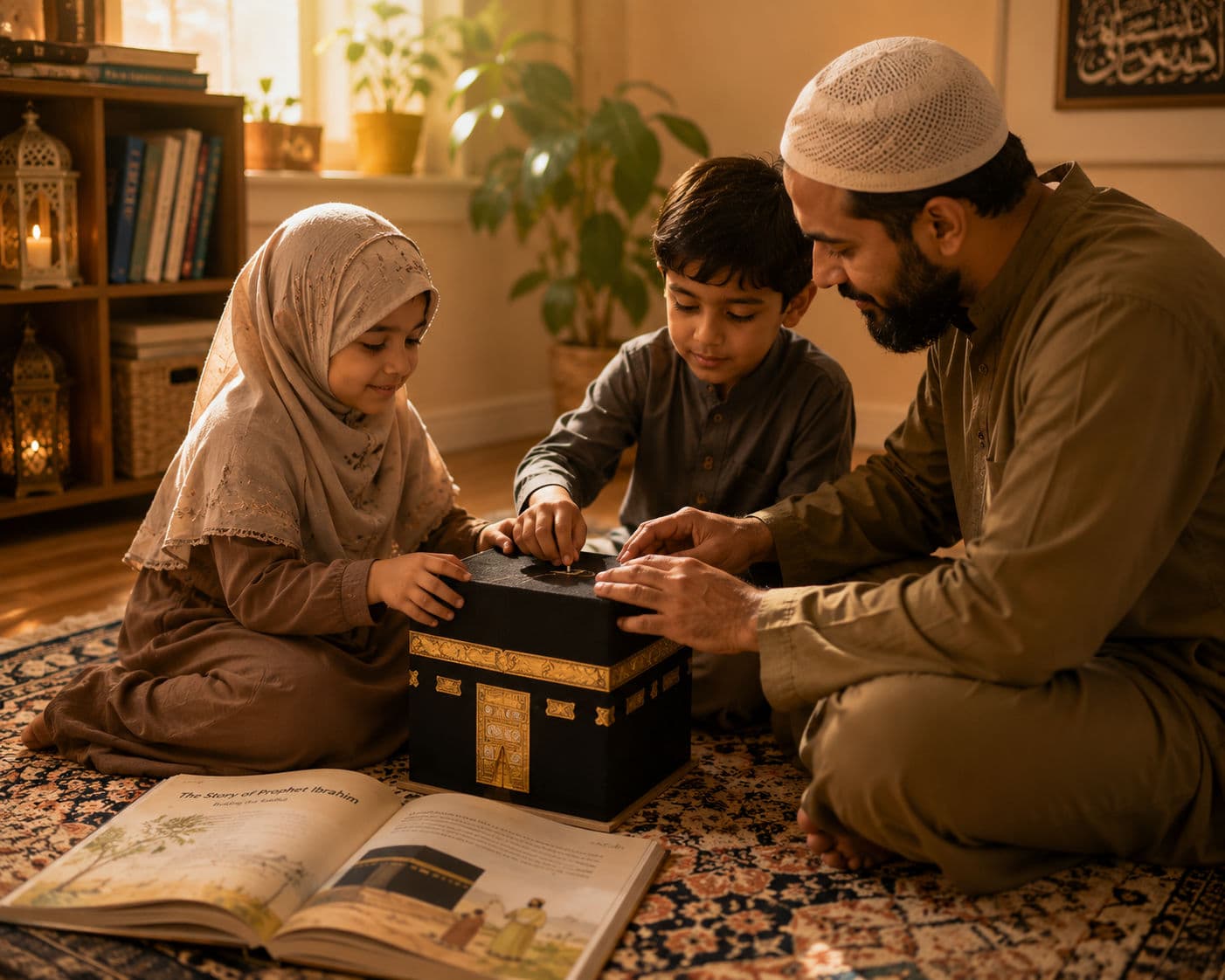
Make it a tradition. On the morning of Eid, before the excitement kicks in, gather everyone — children of all ages — and tell the story of Ibrahim (AS) together. Use a children's Islamic book for the younger ones, let older siblings read aloud, and let parents fill in the depth.
This creates a ritual of meaning before a day of celebration.
2. Create a "Qualities of Ibrahim" Activity
Ask your children to name qualities they saw in Prophet Ibrahim (AS) from the story:
Patience
Trust
Courage
Gratitude
Obedience to Allah
Then ask: "Which of these qualities do you want to practice this Eid?" Let them write it on a card or draw it. It becomes a personal intention — a tiny spiritual goal for the day.
3. Involve Children in the Qurbani Process
Even if children don't watch the slaughter, they can participate meaningfully:
Help choose which animal (if applicable)
Learn about the three portions: family, neighbors, the poor
Help prepare and package the meat for distribution
Personally deliver a portion to a neighbor or someone in need
This last one is especially powerful. When a child hands food to someone who is hungry, something shifts in them. The lesson of generosity becomes felt, not just heard.
4. Make Eid Donations Together
Alongside — or instead of — buying more gifts, involve your child in choosing a charity to donate to this Eid. Let them contribute from their own money, even a small amount.
Talk about:
What kind of need they want to address
Who else in the world is celebrating Eid without enough to eat
What it feels like to give
Research consistently shows that children who practice generosity early develop stronger empathy and long-term wellbeing. And in Islam, this aligns perfectly with the spirit of Qurbani.
5. Learn a New Dua or Surah for Eid
Make a gentle family challenge: learn one new supplication related to Eid al-Adha, gratitude, or Ibrahim (AS). Even a short dua, memorized together, creates a sense of spiritual preparation and achievement.
This is where platforms like Araby Academy can help — online Quran and Arabic lessons designed specifically for children make it easy to weave in Islamic learning that doesn't feel like homework, but like an investment in something real and lasting.
Use Eid al-Adha to Teach Core Islamic Values
What Values Does Eid al-Adha Teach Children?
This holiday is a living curriculum. Here are the values it naturally teaches — and how to draw them out explicitly:
Value | How Eid Teaches It | How to Reinforce It |
|---|---|---|
Tawakkul (Trust in Allah) | Ibrahim's surrender to Allah's will | Discuss moments when trusting Allah was hard but right |
Sacrifice | Giving up something precious | Ask children to "give up" one small thing for the day — screen time, a treat — as symbolic practice |
Gratitude (Shukr) | Recognizing that the ram was a mercy from Allah | Start Eid morning by naming three things you're grateful for |
Generosity | Distributing Qurbani meat to three groups | Involve children in preparing and delivering the portions |
Community | Eid prayer, neighborhood gatherings | Make visiting others a conscious act of building ummah |
When you name these values out loud — "This is what generosity looks like" — children internalize them far more deeply than when they're left implicit.
Rethink the Gift-Giving Tradition
Is It Wrong to Give Gifts on Eid?
Not at all. Gift-giving is a beautiful sunnah and a genuine expression of love. The issue isn't the gifts themselves — it's when gifts become the entire story of Eid.
Here are some ways to reimagine gift-giving so it carries meaning:
Give gifts that grow knowledge:
A beautifully illustrated Quran or Islamic storybook
An online course subscription (like Araby Academy's one-on-one Arabic or Tajweed lessons)
A journal for writing duas or reflecting on Islamic stories
A prayer rug they chose themselves — making salah feel like theirs
Make giving part of receiving:
For every gift a child receives, invite them to give something away — a toy, a book, or a donation. This creates a natural rhythm of gratitude and generosity rather than accumulation.
Try experience gifts:
Instead of objects, give experiences with meaning:
A special outing to the masjid together
A stargazing night where you discuss creation (tafakkur about Allah's signs)
Cooking a meal together to deliver to a neighbor
Enrolling them in an Islamic learning journey they've been curious about
The goal is to shift the frame slightly — not to take away the joy, but to add layers to it.
Eid al-Adha and the Hajj Connection: What Children Should Know
How Is Eid al-Adha Connected to Hajj?
This is a question many children (and adults) don't fully understand, and it's worth spending time on.
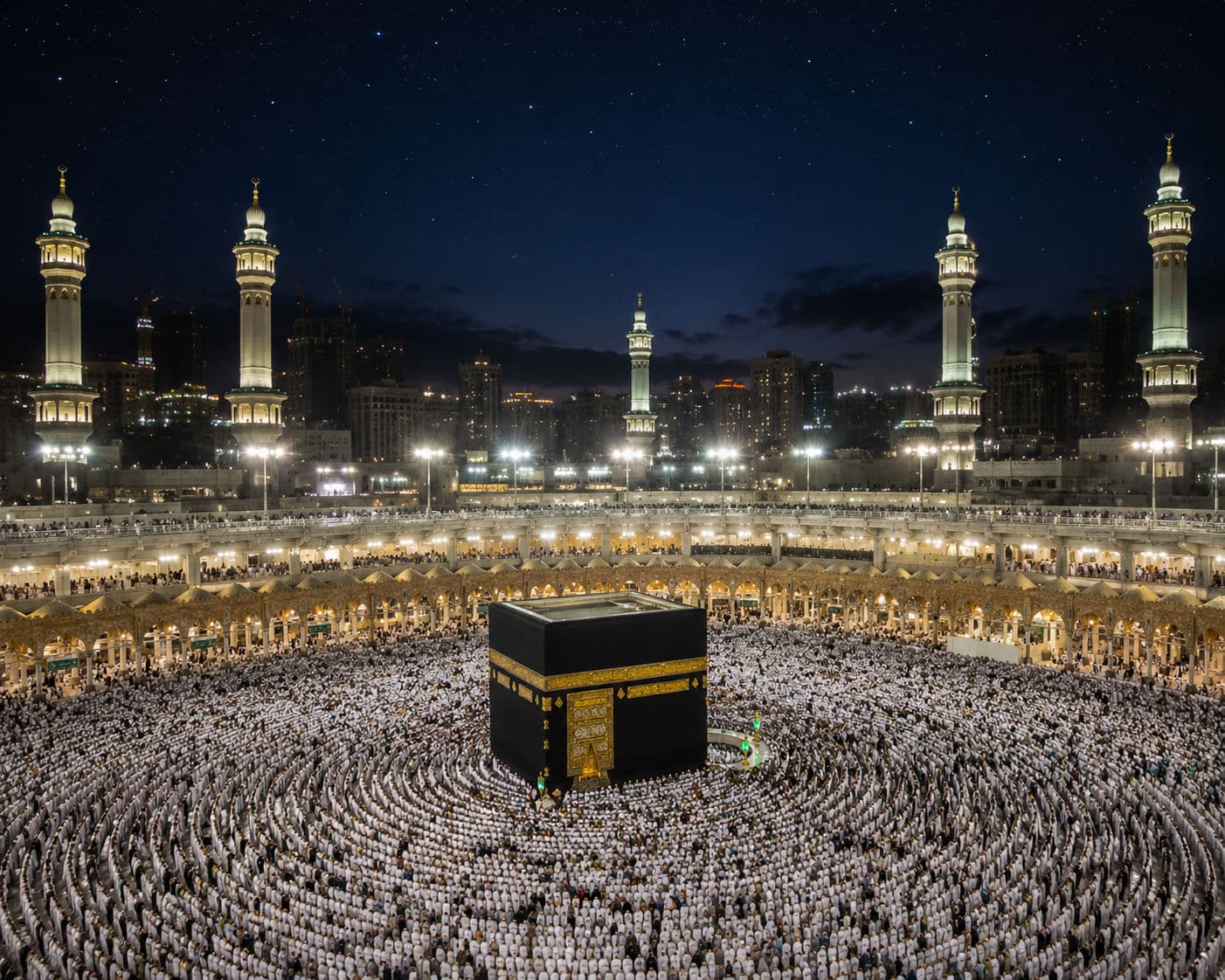
Eid al-Adha falls on the 10th of Dhul Hijjah — the same day that pilgrims in Makkah complete the climax of Hajj, perform their own Qurbani, and shave their heads as a sign of renewal.
When Muslims around the world sacrifice an animal on this day, they are spiritually synchronized with millions of pilgrims standing on the plains of Mina. It's an act of global Islamic unity.
Help your children visualize this:
"Right now, while we're doing this, millions of people in Makkah are doing the same thing."
"The pilgrims walked where Prophet Ibrahim walked."
"One day, insha'Allah, you could go there too."
This sense of connection to the global ummah — and to the history of the prophets — is something that can genuinely inspire a child's Islamic identity.
Building Islamic Identity Through Eid Traditions
How Do Family Traditions Shape a Child's Religious Identity?
Research in developmental psychology consistently shows that children who grow up with meaningful family rituals — religious or otherwise — develop stronger senses of identity, belonging, and resilience.
For Muslim families, Eid al-Adha is one of the most powerful annual opportunities to reinforce:
Belonging — "This is who we are. These are our people."
Purpose — "We do this because it means something beyond ourselves."
Story — "We are part of a history that stretches back to Ibrahim (AS)."
This doesn't happen automatically. It happens through repetition, intention, and conversation.
Here are some traditions worth building:
The Annual Story Morning: Every Eid al-Adha, before anything else, the family gathers to tell the story of Ibrahim (AS). Different family members can take turns telling parts of it each year.
The Gratitude Circle: On Eid morning, everyone shares one thing they're grateful for from the past year. Keep it simple. Keep it honest.
The Community Round: Make it a family tradition to deliver Qurbani portions personally — not just send money. The act of giving directly is irreplaceable.
The Learning Challenge: Each year, every child learns one new thing related to Eid al-Adha, Dhul Hijjah, or Prophet Ibrahim (AS). It could be a hadith, a dua, a historical fact, or a lesson from the story.
These traditions don't need to be elaborate. They just need to be consistent.
The Role of Islamic Education in Making Eid Meaningful Year-Round
Why Eid Alone Isn't Enough
Here's a truth worth sitting with: one day a year is not enough to build a deep Islamic identity in a child.
Eid al-Adha can plant seeds. But those seeds need soil — and that soil is the ongoing Islamic education that happens in the days and months between celebrations.
When a child is learning Quran regularly, practicing Arabic, or studying the stories of the prophets as part of their weekly routine, Eid becomes the celebration of something they're already living — not a brief interruption from a secular life.
This is exactly why platforms like Araby Academy exist. With one-on-one Quran, Tajweed, and Arabic lessons designed for children and adults alike, learning becomes personal, consistent, and genuinely engaging.
When your child can read the Quran with proper Tajweed, recite the surahs related to Ibrahim (AS) with understanding, and hear the Arabic words of the Eid khutbah with some comprehension — Eid stops being a performance and starts being a participation.
That's a profound difference.
Common Mistakes Parents Make on Eid al-Adha
What Undermines the Meaning of Eid for Children?
With the best intentions, many parents unknowingly dilute the spiritual impact of Eid. Here are the most common pitfalls — and how to avoid them:
1. Making Eid entirely about material rewards
When children learn that Eid = new clothes + presents + sweets, they naturally develop a consumer relationship with the holiday. This isn't about banning gifts — it's about ensuring gifts aren't the centerpiece.
Fix: Lead with the story. Let the gifts come after the meaning.
2. Skipping the explanation because "they're too young"
Children are never too young for age-appropriate spiritual stories. A four-year-old can understand love, trust, and sharing. Don't wait until they're "old enough" — start now and build complexity over the years.
Fix: Tell the story of Ibrahim (AS) every year, adjusting the depth as your child grows.
3. Treating Qurbani as a transaction
Many families pay for Qurbani abroad — which is a valid and generous practice — but never connect their children to what that actually means or involves.
Fix: Even if the sacrifice happens elsewhere, talk about it. Show pictures (appropriately). Discuss where the meat goes and who receives it.
4. Isolating Eid from year-round Islamic learning
Eid feels hollow when it's the only Islamic touchpoint in a child's year. Without a foundation, even the most beautiful celebrations don't stick.
Fix: Invest in consistent Islamic education — whether at home, at the masjid, or through structured online learning.
5. Rushing through the day without reflection
Eid days are often chaotic and exhausting. It's easy to get through the prayer, the food, the visits — and realize at bedtime that nothing of depth was said or done.
Fix: Create at least one intentional moment of stillness. The Gratitude Circle at breakfast. A five-minute story. A shared dua before the meal. Small pockets of meaning in a busy day.
Practical Tips for a Meaningful Eid al-Adha with Children
Here's a concise toolkit you can apply this year:
Before Eid:
Read or watch an age-appropriate telling of Ibrahim's (AS) story together
Prepare Eid cards with your children to give to neighbors and family
Involve children in any Qurbani preparations (choosing the animal, understanding the three portions)
Help children choose a charity or person to donate to
On Eid Morning:
Start with Fajr prayer together — make it special
Do the Gratitude Circle at breakfast
Tell or retell the story of Ibrahim (AS)
Discuss the "qualities of Ibrahim" activity
During the Day:
Personally deliver Qurbani portions as a family
Visit elderly family members or neighbors — talk about why community matters
Let children give a small amount to someone in need, personally
In the Evening:
Reflect on the day: "What's one thing you'll remember from this Eid?"
Share a relevant dua or Quranic verse
Let children know this story is their story too
FAQ: Eid al-Adha for Children
What is Eid al-Adha, and how do I explain it to my child?
Eid al-Adha is the Festival of Sacrifice, celebrated on the 10th of Dhul Hijjah. It commemorates Prophet Ibrahim's (AS) willingness to sacrifice his son Ismail (AS) as an act of complete trust in Allah. For children, explain it as a holiday that celebrates loving and trusting Allah above everything else — and sharing what we have with those who need it.
At what age should children start learning about the meaning of Eid al-Adha?
There's no minimum age for age-appropriate stories. Children as young as three or four can understand simple versions: "Ibrahim loved Allah so much, he was willing to give up anything for Him." As they grow, deepen the conversation. The goal is to build understanding gradually, year by year.
How do I make Eid al-Adha meaningful without taking away the fun?
You don't have to choose between meaning and joy — they can coexist beautifully. Start the day with a story and a moment of gratitude, then celebrate fully. The key is ensuring joy has a foundation, not replacing it with lessons.
Should children watch the Qurbani?
It depends on the child's age, temperament, and how it's framed. If a child is ready and the sacrifice is properly explained as an act of worship done with care and mercy — not spectacle — witnessing it can be a powerful, grounding experience. If they're not ready, involve them in the distribution of meat instead.
How can online Islamic education support Eid al-Adha learning?
Year-round Islamic education gives Eid its context and depth. When children are learning Quran, Tajweed, and Arabic regularly — through platforms like Araby Academy — they arrive at Eid with vocabulary, knowledge, and connection that makes the celebration far richer. They recognize the Arabic of the Eid prayer. They understand the stories. They feel part of something ongoing, not just something annual.
What are the best books or resources to help children understand Eid al-Adha?
Look for illustrated Islamic storybooks about Prophet Ibrahim (AS) for younger children. For older children, explore age-appropriate biographies of the prophets. Supplementing with structured Arabic and Quran learning ensures they can access the primary source — the Quran itself — directly over time.
How do I balance gift-giving with teaching generosity on Eid?
The balance is in the framing. Gifts are lovely — they communicate love and celebration. But pair every gift with an act of giving: let your child contribute to a charity, prepare a Qurbani portion, or give something of their own to someone else. When giving and receiving happen together, generosity becomes natural, not obligatory.
Final Thoughts
Eid al-Adha is one of Islam's greatest gifts to families.
It's a day that holds within it one of the most profound stories ever told — a story of a father, a son, a ram, and a God who sees and responds to the deepest sincerity of the human heart. That story deserves to be more than background noise to a day of shopping and feasting.
Your children are at an impressionable age. The traditions you build now, the conversations you start today, the meaning you weave into the fabric of this holiday — these things stay. They become the scaffolding of an Islamic identity that your children will carry into adulthood, and one day, pass on to their own children.
You don't have to be perfect at this. You don't need elaborate plans or expensive programs. You just need intention.
Tell the story. Ask the questions. Share the meat. Give something away. Make space for gratitude.
And if you want to give your child the gift that truly keeps growing — the ability to connect with the Quran and Islamic knowledge directly, in Arabic, with understanding — explore what Araby Academy has to offer. Our one-on-one Quran, Tajweed, and Arabic lessons are designed for real students at real stages of life, with teachers who genuinely care about your child's growth.
Because Eid al-Adha isn't just one day. It's a door. And what's on the other side is a lifetime of meaning.
Eid Mubarak. May Allah accept from all of us.